
Bias Network Design for X-Band GaAs MMIC Amplifier: Complete Implementation and Best Practices

Introduction

A bias network is used to supply the necessary DC voltages to the terminals of any amplifier. The main design goals for the bias network are:

  1. RF-DC isolation >20 dB

  2. RF port return loss >15 dB

  3. RF insertion loss <0.1 dB

We need to achieve the above goals specifically for X-band (8-12 GHz) for the Scope of this Blog Post.


Step 1: Inductor / Choke Design

To begin the bias network design, we first need to design an inductor for the DC choke (or DC feed) that allows DC to pass while blocking higher frequencies. By leveraging the nonlinear behavior of the inductor near its self-resonant frequency (SRF), we can achieve maximum impedance for X-band frequencies.

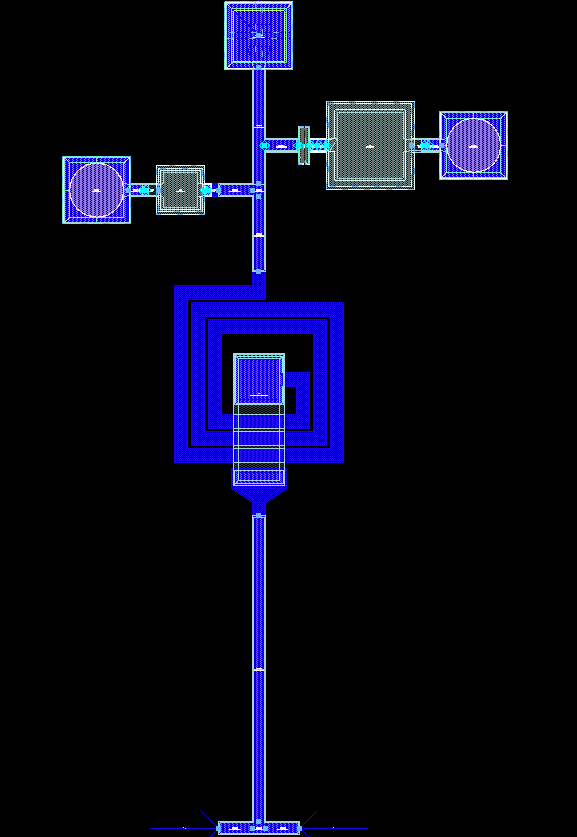
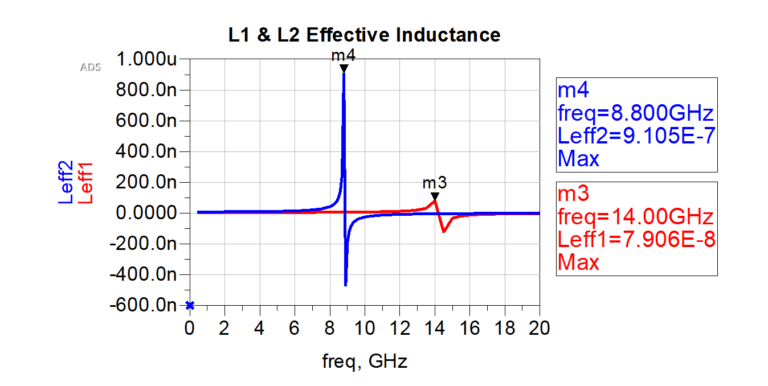
For this purpose, we designed a 3-turn inductor using a 20 µm wide transmission line, 5 µm spacing, and a 74 µm thick underpass layer-chosen to handle higher source biasing DC currents due to its lower current-carrying capacity. This configuration places the SRF at 12 GHz, aligning with the upper end of the X-band.

Step 2. Bypass Capacitor Design

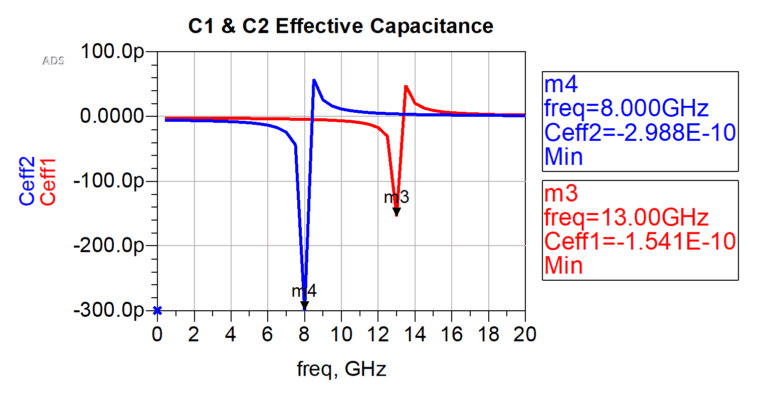
Similarly, for the DC blocking or bypass function in the bias network, we design a capacitor that blocks DC while allowing RF signals to pass. By selecting a 3 pF capacitor which has a self-resonant frequency (SRF) at 12 GHz, we ensure it provides low impedance across the X-band. This takes advantage of the capacitor’s minimum impedance at SRF, making it highly effective for bypassing the leakage RF to Ground by providing minimum impedance path to Ground / GND.

Step 3. Schematic Design for Bias Network

In the schematic design of the bias network, the inductor with its self-resonant frequency (SRF) near the upper end of the X-band is placed in series with the DC path to act as a DC choke, allowing DC to pass while providing high impedance to X-band frequencies. The SRF capacitor is positioned in shunt to ground, bypassing unwanted RF signals and ensuring they do not leak into the DC supply. RF ports are connected for signal input and output, and a DC pad is provided for bias voltage application. This configuration effectively achieves high RF-DC isolation, low insertion loss, and good return loss, all of which are essential for stable and efficient amplifier operation in X-band.

Step 4. Final Layout Design

In the final layout, an additional high-value shunt capacitor is placed near the DC pad to compensate for the inductive effects introduced by bond wires and solder bonds. A small-value resistor is added in series with this shunt capacitor to prevent it from adversely affecting the bias network. This approach helps to suppress potential oscillations caused by parasitic inductance from bonding and wiring, thereby ensuring amplifier stability

Results Achieved

  1. RF Port Return Loss: > 20 dB

  2. RF Insertion Loss: < 0.05 dB

  3. RF to DC Isolation: < –35 dB (better than –35 dB

The Performance Was Maintained Across the entire X-band frequency range.


These results demonstrate that the final bias network layout not only met but surpassed the original design goals, ensuring high performance and stability for X-band GaAs MMIC amplifier applications.

Explore Other Blog Posts

Abhi’s Lab Microstrip Line Calculator

Target Impedance Z0 (Ω) Substrate Height h (mm) Initial Step Fraction Tolerance (%) Dielectric Constant Er Electrical Length (degrees) Frequency (GHz) Explore Other Blog Posts Abhi’s Lab...

Bias Network Design for X-Band GaAs MMIC Amplifier: Complete Implementation and Best Practices

Introduction A bias network is used to supply the necessary DC voltages to the terminals of any amplifier. The main design goals for the bias network are: RF-DC isolation >20 dB RF port return loss...
Capacitor Parasitics and SRF in GaAs MMIC Technology: A Combined Experimental and Theoretical Approach

Introduction Capacitors are equally vital in RF and microwave circuits, enabling critical functions like DC blocking, impedance matching, and harmonic filtering. However, their high-frequency...
Inductor Parasitics and Self-Resonant Frequency: Experimental Validation of Theory

Inductors are indispensable components in RF and microwave circuits, playing crucial roles in filtering, impedance matching, and signal tuning. However, their behavior at high frequencies is far from...

Leave a Comment

Your email address will not be published. Required fields are marked *